
History
About CIRT
Central Institute of Road Transport..Testing Purpose
Institutional Profile & Key Milestones (1967–2026)
Pune | Established 1967 | Ministry of Road Transport & Highways
Brief about CIRT
Established in 1967 through a joint initiative of the Ministry of Road Transport & Highways (MoRTH) and the Association of State Road Transport Undertakings (ASRTU), the Central Institute of Road Transport has, for over five decades, served as India’s apex organization for vehicle and component testing & certification, automotive research, consultancy, training & Capacity building. Authorized under Rules 124 and 125 of the Central Motor Vehicles Rules (CMVR),by MoRTH, Govt of India, CIRT plays a pivotal role in defining and upholding road transport safety standards while enhancing the efficiency and productivity of the transport sector, particularly State Transport Undertakings (STUs), Automotive OEMs, and Tier-1 & Tier-2 component suppliers.
Divisions of CIRT
Safety & Homologation Division (SHD)
Established under authorization (CMVR Rule 126) of the Ministry of Road Transport & Highways (MoRTH), Government of India, the Safety & Homologation Division (SHD) of CIRT is primarily responsible for Complete Vehicle & Automotive Component Type Approval and development of Automotive Industry Standards (AIS) and Bureau of Indian Standards (IS).
The Division’s strength lies in its experienced engineering professionals and the support of the Automotive Testing Division with eleven NABL-accredited laboratories equipped with state-of-the-art testing facilities for vehicles and components. SHD conducts type approvals for a wide range of vehicles, from two-wheelers to heavy commercial vehicles, construction equipment vehicles (CEVs), and agricultural tractors.
Key activities of SHD include
Type Approval Certification (TAC) and Conformity of Production (COP) for vehicles and safety components under CMVR.
- Research & Development projects on alternative fuels and technologies such as LNG buses and Hydrogen Fuel Cell Vehicles in collaboration with MoRTH, CSIR laboratories, MEDA, and startups.
- Approval of imported vehicles based on EEC/ECE/Japanese Whole Vehicle Type Approval Certificates.
- Accreditation and audits of bus manufacturers and bus body builders.
- Development of Automotive Industry Standards (AIS) and participation in national standardization committees.
- Technical support and third-party inspections for bus procurement and PM E-Bus projects.
- Audits of Automated Testing Stations (ATS) and Registered Vehicle Scrapping Facilities (RVSF).
Recent major achievements include Electric Bus Type Approval Certification projects for manufacturers such as Olectra Ltd., Veera Vidhut Vahana Pvt. Ltd., Aero Eagle Automobiles Pvt. Ltd., and M&M Ltd., along with various range testing, structural tests, installation-level tests, and AIS-052, AIS-119, and AIS-153 bus body approvals across India.
Bharat New Car Assessment Programme (Bharat NCAP)
As the Designated Agency for the Ministry of Road Transport and Highways (MoRTH), CIRT leads the operational and technical governance of the Bharat New Car Assessment Programme (BNCAP). Bharat NCAP is India's independent voice on vehicle safety and the official New Car Assessment Program for India. It was launched by MoRTH, Government of India on 22 August 2023.
Automotive Cybersecurity Division
CIRT has established the Automotive Cyber Security Division to address emerging cyber threats in connected, software-defined, electric, and intelligent vehicles. The Division is dedicated to strengthening cyber resilience across the automotive ecosystem and supporting the industry in meeting evolving national and global cybersecurity regulations and standards.
The key activities undertaken by the Division include:
- Automotive Cybersecurity Assessment, Testing, Vulnerability Analysis, and Penetration Testing (VAPT)
- Cybersecurity Risk Assessment, Gap Analysis, and Compliance Support for ISO/SAE 21434, UNECE R155/R156, and AIS-189
- Software Update Management System (SUMS), Connected Vehicle, V2X, and EV Cybersecurity Evaluation
- Cybersecurity Audits for issuance of CoC for CSMS & SUMS, Vehicle Type Approval for AIS:189/190, Technical Consultancy, and Functional Safety Integration Support
- Research & Development in Emerging Automotive Technologies and Cybersecurity Frameworks
- Specialized Training, Workshops, Capacity Building, and Industry Collaboration Initiatives
Through its advanced technical expertise and industry-oriented approach, CIRT aims to play a pivotal role in building a secure, resilient, and future-ready automotive ecosystem for India.
Research & Consultancy Division
The Research & Consultancy Division undertakes monitoring, execution support, Project Management Consultancy (PMC), and evaluation activities for a wide range of projects funded by the Ministry of Road Transport and Highways (MoRTH). The Division plays a key role in supporting national initiatives related to road safety, driver training, vehicle testing, and public transport modernization across various states in India.
Its areas of engagement include Integrated Driving Training Institutes (IDTRs), Regional Driving Training Centres (RDTCs), Driving Training Centres (DTCs), Automated Driving Testing Tracks (ADTTs), Automated Testing Stations (ATS), and the procurement and deployment of Electric, Diesel, and CNG buses for public transport systems.
Training & Management Development Centre
CIRT offers Management Development Programmes covering Foundation & Refresher Training for Officials of Motor Vehicles Department, Police Departments etc. general management, transport operations and maintenance engineering to STUs.
CIRT has strengthened its core competence and was playing major role in capacity building for the Officers of Motor Vehicles Department, Police Departments & STUs and is now regarded as a major Management Development Centre in the country by training 80,000+ officials through 2000+ training programmes conducted in last half century.
CIRT is having State-of-the-art training infrastructure comprising a modern auditorium, conference hall, seminar halls, fully equipped classrooms, hostels, and guest house facilities, with the capacity to accommodate and train up to 120 participants at a time.
Automobile Component Testing
The Central Institute of Road Transport (CIRT) houses a comprehensive suite of advanced testing laboratories accredited by National Accreditation Board for Testing and Calibration Laboratories (NABL) and recognized by the Bureau of Indian Standards (BIS) for evaluation and certification of a wide range of automobile components. These state-of-the-art facilities include the Tyre Laboratory, Vehicle Component Laboratory (VCL), Electrical Laboratory, Polymer Laboratory, Photometric Laboratory, and Auto Laboratory, along with specialized facilities such as the Structural Dynamics Laboratory, Environmental Laboratory, Petroleum Laboratory, Metallurgical Laboratory, and Chemical Laboratory for rigorous testing, analysis, and quality monitoring.
The laboratories provide critical testing and validation services to State Transport Undertakings (STUs), vehicle manufacturers, and Tier-1 & Tier-2 component suppliers, ensuring that automotive parts and systems comply with applicable safety, performance, durability, CMVR, and BIS standards while promoting reliability, quality, and cost-effectiveness in the automotive and road transport sector.
Publications
The Central Institute of Road Transport (CIRT) publishes the Indian Journal of Transport Management (IJTM) quarterly and the State Transport Undertakings (STUs) – Profile & Performance annually. These publications provide valuable insights into the transport sector and are widely referred to by organizations such as the Planning Commission, World Bank, and other leading national and international institutions.
Over the years, IJTM has emerged as an important platform for the exchange of ideas on road transport, transport policies, management practices, and broader mobility issues. The annual STUs – Profile & Performance publication serves as a key reference for analysing and benchmarking the operational and financial performance of State Transport Undertakings across India.
Accreditations & Recognitions
MoRTH Recognition: Having MoRTH Authorization under CMV Rules 124 & 126 as a notified Testing and Certification Agency for Vehicle & Component Certification.
MoRTH AISC Secretariat: For Vehicles with GVW exceeding 3.5 Tonnes
NABL Accreditation: All the Labs of CIRT are having Accreditation by National Accreditation Board for Testing and Calibration Laboratories (NABL).
BIS Accreditation: For Tyres, Tubes & Wheel Rims testing
MoRTH Secretariat: CIRT have established MoRTH Secretariat for Global Forum for Road Traffic Safety, WP.1 of UNECE
SIRO Recognition: CIRT is having recognition by Scientific & Industrial Research Organisation by DSIR, Ministry of Science & Technology, Government of India
Key Milestones (1967–2026)
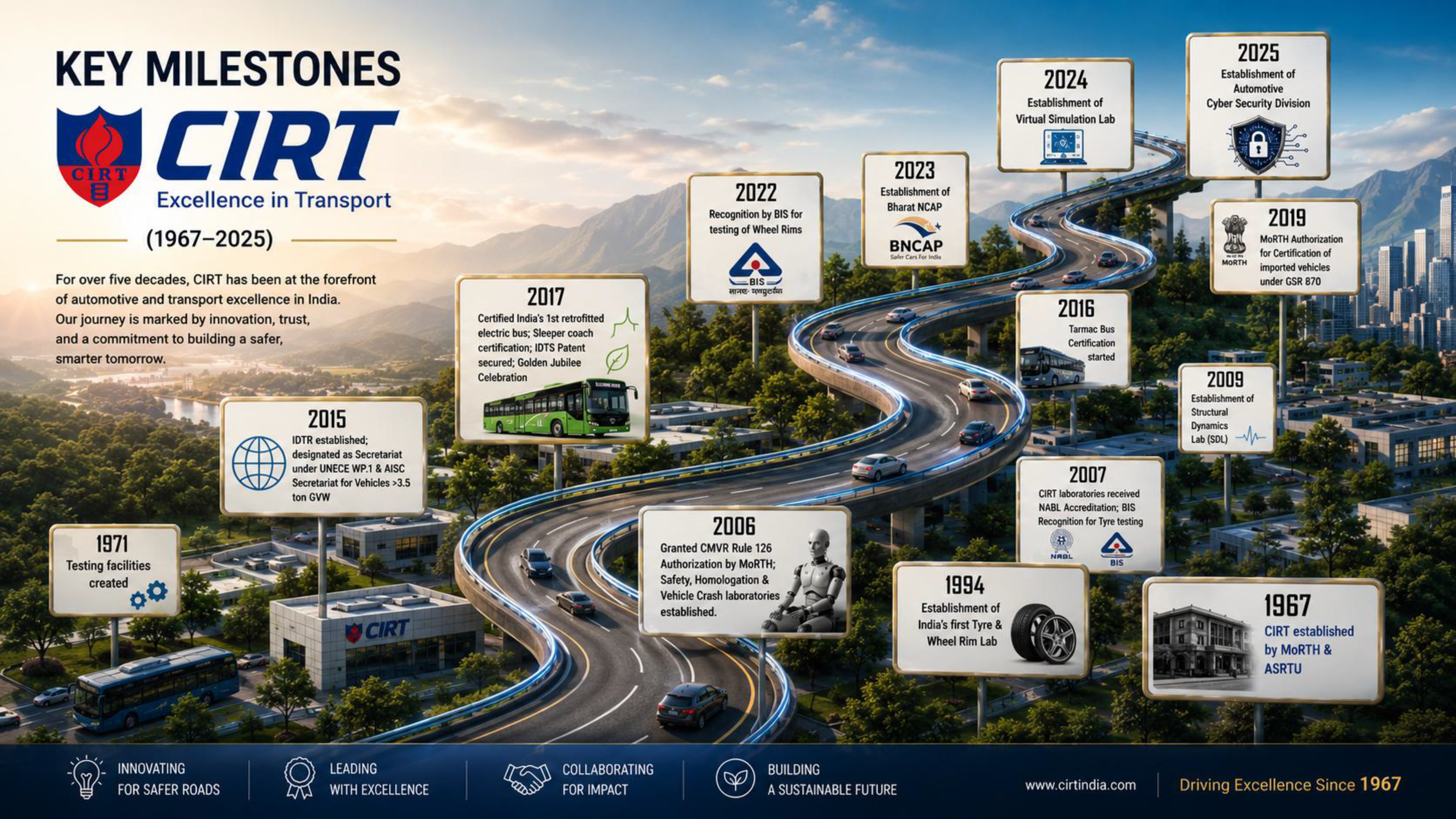
The following timeline documents CIRT's institutional journey from its founding in 1967 to the present, capturing landmark achievements in testing, certification, Training, Consultancy homologation, digital mobility, and automotive cybersecurity.
| Year | Milestone |
|---|---|
| 1967 | The Central Institute of Road Transport (CIRT) was established on the joint initiative of the Ministry of Road Transport & Highways and the Association of State Road Transport Undertakings (ASRTU). |
| 1971 | Vehicle testing facilities were created to support scientific evaluation and certification of automotive systems and components. |
| 1994 | India’s first Tyre & Wheel Rim Laboratory was established in CIRT. |
| 1994 | CIRT received CMVR Rule 124 Authorization by MoRTH, enabling certification of automotive components and systems. |
| 2006 | Granted CMVR Rule 126 Authorization by MoRTH for complete vehicle homologation; Safety & Homologation and Vehicle Crash laboratories were also established. |
| 2007 | CIRT laboratories received NABL Accreditation, enhancing international credibility and technical competence. Recognition by Bureau of Indian Standards (BIS) for testing of Tyres. |
| 2009 | Major initiatives launched including Structural Dynamics Lab (SDL), DPR for ITS in KSRTC, and the BusIndia platform to support intelligent transport systems and digital mobility. |
| 2015 | Key achievements included establishment of IDTR, designation of CIRT as Secretariat under the United Nations Economic Commission for Europe (UNECE) WP-1 and AISC Secretariat for Vehicles above 3.5 ton GVW. |
| 2016 | CIRT expanded certification services to include Powertrain and Tarmac Bus Certification. |
| 2017 | Certified India's first retrofitted electric bus, celebrated its Golden Jubilee, introduced sleeper coach certification, and achieved the IDTS Patent milestone. |
| 2019 | Got Authorization by MoRTH, Govt. of India for Certification of imported vehicles, under GSR 870. |
| 2022 | Recognition by Bureau of Indian Standards (BIS) for testing of Wheel Rims. |
| 2023 | Establishment of Command & Control Centre for the Bharat NCAP for award of Star Rating to M1 categories of Vehicles based on their safety features |
| 2024 | Established a Virtual Simulation Laboratory for advanced automotive testing and digital validation technologies. |
| 2025 | Automotive Cyber Security Division was established for CMVR Certification of Connected Vehicles under AIS:189 & AIS:190 & support for V2X objectives of MoRTH. |
| 2026 | CIRT continues to lead India's automotive and transport sector through advancements in testing, certification, intelligent mobility, electric vehicles, road safety, and cybersecurity & V2V initiative of MoRTH. |
Employee Profile
Global Footprint

CIRT being the only national level institution in India dealing exclusively with road transport matters, it does collaborate with similar institutions elsewhere in the world. The Institute's training and consultancy services have been, and are being, patronised by neighbouring countries. Its academic and training links have however taken it across the continents.
In respect of testing of automobile components, the Institute has entered into memoranda of understanding with TUV in Munich, Germany, and with UTAC in Paris, France. Under a scheme supported by the European Union, scientists from these two renowned automobile laboratories visited CIRT and helped in upgrading testing facilities. A good number of CIRT scientists were also trained in these two laboratories.
Collaborative efforts are being made in the areas of road safety with appropriate institutions in Australia, Europe, Japan and USA.
The Dutch government and the Institute of Road Safety Research at the Hague have shown interest not only in collaborating with CIRT in road safety but in helping establish the Centre for Road Safety on CIRT campus.
Global FORM FOR Road Traffic Safety (WP.1)
Advance Automotive Testing and Development Centre (AATDC)
CIRT is establishing the Advance Automotive Testing and Development Centre (AATDC) which will have the world class facility for testing, certification and development of Automotive Vehicle for domestic market and export.
CIRT has signed the Contract with the Applus+ IDIADA. Applus+ IDIADA is a global partner to the automotive industry with over 30 years’ experience supporting our clients in product development activities by providing design, engineering, testing, and homologation services.
QUANTIFY Project: Quantifying the Climate Impact of Global and European Transport Systems
CIRT had participated in ‘QUANTIFY Project’ under 6th Research Framework Programme of EU for Global Change & Ecosystems. DLR Institute of the Atmospheric Physics, Germany was the coordinating agency for the project.
The main goal of QUANTIFY was to quantify the climate impact of global and European transport Systems for the present situation and for several scenarios of future development for assessing the climate impact of various transport modes (land surface, shipping, and aviation), including those of long-lived greenhouse gases like CO2 and N2O. The project goal included provision of forecasts and other policy-relevant advice, to governments and to international assessments of climate change and ozone depletion, such as the IPCC reports (Kyoto Protocol) and WMO-UNEP ozone assessments (Montreal Protocol).
CIRT was involved in Activity 1 of the project for building Emission Inventories for Land Transport for India. As a part of the project CIRT had developed ‘Real World Driving Cycles ‘for 2-wheeler and Car. Real world driving cycles, so developed were used for Emission Measurements on Chassis Dynamometer to obtain Emission Factors. These emission factors were used for building ‘Transport Emission Inventory’ for India. Emission Inventories were built up for various categories of vehicles using Fleet Level emission factors.
Awards & Recognition
National and International Achievements
Quality Policy
We at CIRT are committed to provide consistent quality and continuous improvement of our services in management training, consulting, research and testing through a process of team work for the utmost satisfaction of our customers and to achieve international recognition for our contribution to the transport sector.
Related Links
Members of ASRTU
Members of the Association of State Road Transport Undertakings = 63 + 3
Visit ASRTU Website →| # | Name of Department | Website |
|---|---|---|
| 1 | Andaman & Nicobar ST | |
| 2 | Arunachal Pradesh ST | |
| 3 | Chandigarh TU | |
| 4 | Mizoram ST | |
| 5 | Nagaland ST | |
| 6 | Sikkim NT | |
| 7 | ST Haryana | |
| 8 | ST Punjab |
| # | Name of Company | Website |
|---|---|---|
| 1 | Calcutta Tram. Co. Ltd. | |
| 2 | Kadamba TCL | |
| 3 | Metropolitan TCL (CNI-I & II) | |
| 4 | Pondicherry TDCL | |
| 5 | State Express TCL (TN-I) | |
| 6 | State Express Transport Corporation Tamilnadu Ltd. | |
| 7 | Tamil Nadu State TCL (CBE-I & III) | |
| 8 | Tamil Nadu State TCL (CBE-II) | |
| 9 | Tamil Nadu State TCL (KUM-I) | |
| 10 | Tamil Nadu State TCL (KUM-II) | |
| 11 | Tamil Nadu State TCL (KUM-III) | |
| 12 | Tamil Nadu State TCL (KUM-IV) | |
| 13 | Tamil Nadu State TCL (MDU-I) | |
| 14 | Tamil Nadu State TCL (MDU-II) | |
| 15 | Tamil Nadu State TCL (MDU-III) | |
| 16 | Tamil Nadu State TCL (MDU-IV) | |
| 17 | Tamil Nadu State TCL (SLM-I) | |
| 18 | Tamil Nadu State TCL (SLM-II) | |
| 19 | Tamil Nadu State TCL (VPM-I) | |
| 20 | Tamil Nadu State TCL (VPM-II) | |
| 21 | Tamil Nadu State TCL (VPM-III) | |
| 22 | Tamil Nadu State TCL(MDU-V) | |
| 23 | West Bengal Surface TCL |
| # | Name of Undertaking | Website |
|---|---|---|
| 1 | Ahmedabad municipal transport service | |
| 2 | Bangalore Metropolitan Transport Corporation | |
| 3 | BEST Undertaking | |
| 4 | Kolhapur Municipal Transport Undertakings | |
| 5 | Navi Mumbai Municipal Transport Undertaking | |
| 6 | Pimpri Chinchwad MT | |
| 7 | Pune Mahanagar Parivahan Mahamandal Ltd. | |
| 8 | Sholapur Municipal Transport Undertaking |
http://www.solapurcorporation.gov.in/Default.aspx?AspxAutoDetectCookieSupport=1 |
| 9 | Thane Municipal Transport |
| # | Name | Website |
|---|---|---|
| 1 | Delhi Tourism DC | |
| 2 | Himachal Pra. TDCL | |
| 3 | The National TC, Mauritius |